
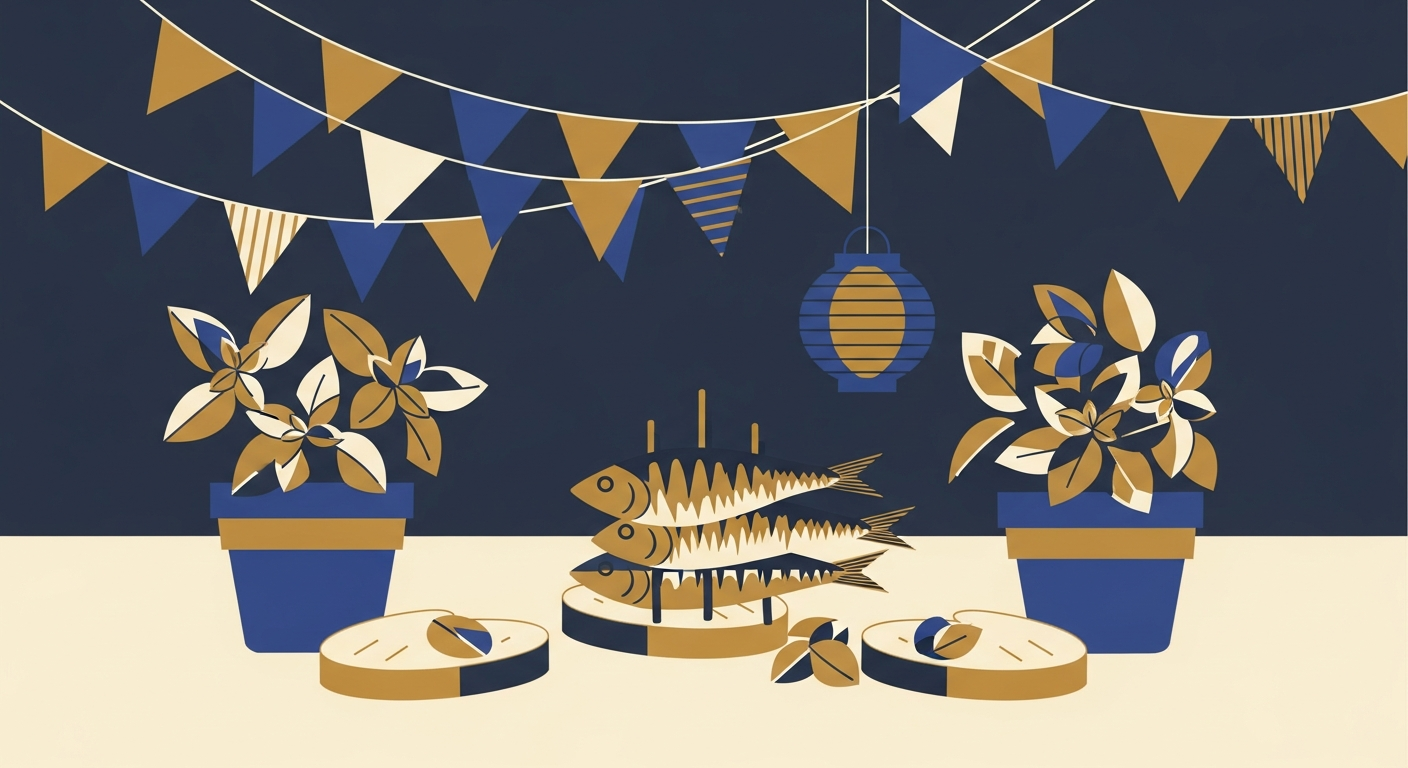
The night of the 12th of June is the loudest, smokiest, most genuinely Lisboeta night of the year. The marchas populares process down Avenida da Liberdade, sardines grill on every corner from Alfama to Madragoa, brass bands play in the Campo de Santa Clara, and the historic neighbourhoods compete for the festa’s biggest prize. The 13th is a public holiday in Lisbon — and only in Lisbon — because it is the feast day of Santo António, the city’s most beloved saint.
For buyers thinking about whether central Lisbon is the right fit, Santo António is the single best stress test. If you love the noise, the smoke, the music drifting through your windows until 4am — historic central Lisbon is for you. If you do not, you need to know that now.
This is an honest guide to what the festa actually is, where it happens, and what to expect.
Who was Santo António?
Santo António de Lisboa (St Anthony of Padua, in English) was born in Lisbon around 1195 — by tradition, in a house just behind the Sé cathedral, where the small Igreja de Santo António now stands. He joined the Franciscan order, preached across Portugal and Italy, and died in Padua in 1231. He was canonised the following year.
In Portugal he is the patron saint of marriages, of lost things, and — informally but firmly — of Lisbon itself. The Vatican may have him as Anthony of Padua; Lisboetas have him as theirs.
His feast day is 13 June — the date of his death. The big celebration is the night before.
Why is the 13th of June a public holiday?

The 13th of June is a municipal holiday in Lisbon, granted in honour of the city’s patron saint. Schools, banks, most offices and the câmara are all closed. The rest of Portugal works as normal — which is one of the reasons the city feels distinctly Lisboeta on the day.
If you are buying a flat to live in Lisbon, this is a useful detail: the 12th–13th is one of the genuine “the city is doing its own thing” weekends in the calendar.
The festa programme — what actually happens
The Festas de Lisboa programme runs from late May through the end of June and is organised by the city through EGEAC (the municipal cultural arm) and the Câmara Municipal. The flagship events all cluster around 12–13 June.
The marchas populares — the centrepiece
The marchas populares are the festa’s defining spectacle. Each historic bairro enters a choreographed parade group of around 100 people — couples in matching costume, dancing in formation, with a song, a theme, and a designated arch (arco). They process down Avenida da Liberdade from Marquês de Pombal to Restauradores on the night of the 12th of June, in front of a panel of judges who score them for choreography, costume, song, theme and arch.
It is genuinely competitive. The bairros take it seriously — months of rehearsal, professional costumiers, original music written for the year. The winning marcha gets a prize, the bairro gets bragging rights for twelve months, and the local colectividade (community association) that organises the marcha is the centre of the bairro’s social life all year round.
The traditional bairros marchantes are:
- Alfama
- Bairro Alto
- Castelo
- Bica
- Madragoa
- Mouraria
- Graça
- São Vicente
- Alto do Pina
- Ajuda
- Belém
- Olivais
- Marvila
- Lumiar
- Carnide
- Penha de França
- Campo de Ourique
- Santa Clara
- Boavista
- Bairro da Liberdade
The lineup shifts a little year to year, but Alfama, Bairro Alto, Castelo, Bica and Madragoa have been at the heart of it for decades. Rehearsal venues, called colectividades, are spread across each bairro and you can hear the songs being practised through the windows of these clubhouses for months before the night.
The arraiais
The arraiais are the open-air street parties. Every historic neighbourhood — Alfama, Bairro Alto, Bica, Madragoa, Castelo, Mouraria, Graça, Martim Moniz — runs its own across the night of the 12th and into the early hours of the 13th, often continuing through the following weekend.
What an arraial actually is: streets are decorated with paper bunting, coloured lights and pots of basil. Trestle tables are set up. Charcoal grills run sardines, bifanas (pork sandwiches), pork ribs and espetadas (skewers). Imperials (small beers) are €2. There is live music — a singer, a small band, sometimes a DJ later in the evening. Sometimes a stage; often just the street. People dance.
Each arraial has a slightly different character. Alfama is the most touristed but also the most atmospheric — narrow medieval streets, the smell of grilled fish, fado drifting from open doors. Bica is steep, tight, intensely local. Madragoa, between Estrela and Santos, is one of the most genuinely Lisboeta — local families, neighbours who have done this for decades, very little tourist presence. Castelo is small but spectacular, with views over the city.
If you are choosing one to attend for the first time and want the most authentic experience, Madragoa or Bica. If you want the postcard, Alfama. If you want the buzz of a major event, the streets around Santa Catarina and Bairro Alto.
The casamentos de Santo António
Santo António is the patron saint of marriages, and the city marries dozens of couples each 12 June at the Sé cathedral in a tradition called the Casamentos de Santo António, going back to 1958. Couples apply months in advance; the city pays for the ceremony, the dress and the rings for those who need it. The brides and grooms parade through central Lisbon afterwards, are toasted at the Câmara Municipal, and join the festa.
You will see the wedding processions winding through the historic centre on the day of the 12th — beautiful, slightly chaotic, very Portuguese.
The Trono de Santo António
In the historic neighbourhoods, families build small tronos (thrones) for Santo António outside their doors and along the streets — miniature shrines to the saint, decorated with flowers, ribbons and pots of basil, with a coin tray for donations to the local colectividade. Children traditionally guard them and ask passers-by for a tostão para o Santo António (a coin for Santo António). It is one of the festa’s most charming and least-touristed traditions.
The supporting cast of the festa

Sardines
Grilled sardines (sardinhas assadas) are the food of the festa. They are grilled over charcoal in the open air, served on a slice of country bread that absorbs the oil, eaten with the fingers. €4–€6 each. Sardine season peaks in June, when the fish is at its fattest and best — which is part of why the festa happens when it does.
The city runs a competition each year called Sardinha — an open call for graphic designers and illustrators to submit a sardine illustration. The winners are reproduced as official festa imagery on banners, T-shirts, posters and merchandise across the city. Spotting the year’s official sardines is its own small pleasure.
Manjericos
The manjerico is a small basil plant given as a gift during the festa. Tradition says you should not smell it directly — you brush the leaves with your hand and smell your fingers. Most manjericos are sold with a small paper flag bearing a quadra popular (a four-line traditional rhyme), often comic, often romantic. Giving someone a manjerico on the night of the 12th is a small, half-joking declaration of affection.
You will see manjericos in every shop, every café, every tasca window across the historic centre from the start of June. Most cost €3–€5.
Caldo verde, bifanas and pork
Beyond sardines, the festa food canon includes:
- Caldo verde — a green soup of kale and potato with chouriço.
- Bifana — a thin pork loin sandwich with mustard.
- Espetadas de porco — pork skewers, grilled.
- Pão com chouriço — bread baked around a chouriço.
- Imperial — a 0.2L draught beer, the festa standard.
- Ginjinha — sour cherry liqueur, traditionally served in small chocolate cups at festa stalls.
A full festa dinner from a street stall costs €15–€25 per person, eaten standing up.
Where the festa is concentrated
The historic core is the heartland. Specifically:
- Alfama — the busiest and most touristed, with the densest concentration of arraiais. The streets around Largo do Chafariz de Dentro, Beco do Carneiro and Rua de São Pedro are at the heart of it.
- Bairro Alto and Bica — west of Chiado, narrow streets, a younger crowd, music spilling out of every bar.
- Martim Moniz — the multicultural quarter, with arraiais throughout the streets climbing toward the castle.
- Graça — quieter than Alfama, more Lisboeta, excellent miradouro views over the festa below.
- Madragoa and Santos — between Estrela and the river, intensely local, family-led.
- Castelo — small, steep, atmospheric.
- Avenida da Liberdade — the marchas processional route on the night of the 12th.
If you are buying anywhere in this central historic zone, the festa will be on your doorstep. If you are buying in Estrela, Príncipe Real, Avenidas Novas, Parque das Nações, Alvalade or Campo de Ourique, you can attend by walking or on the metro but live mostly outside it.
What it is genuinely like to live through
A few honest observations from clients who have lived through it.
The smoke is real. Sardines grilling over open charcoal produce a lot of smoke. If you live on a low floor in an Alfama or Bica street with grills below, your apartment will smell of grilled fish for two weeks. Most residents close shutters and find it charming. Some find it unbearable. Worth visiting in mid-June before committing if you are sensitive to it.
The noise runs late. Arraiais run until 4am, sometimes 5am. Music is amplified. Singing and dancing in the streets is the norm. Triple-glazed windows help; if you are a light sleeper, it is something to consider in the most concentrated streets.
The first week is the loudest. The festa builds toward the 12th. The night of the 12th is the peak. Things wind down through the third week of June, but smaller arraiais continue until end of month.
It is not aimed at tourists. The festa has tourists in it — Alfama especially — but the marchas, the casamentos, the colectividades and the quadras populares are organised by and for Lisboetas. The fact that you can stumble into all of it with no introduction is part of what makes it so welcoming.
Most residents love it. In our experience, very few buyers regret being inside the festa. Most who buy in the historic centre look forward to it.
Practical advice if you are visiting
- Bring cash. Stalls and arraiais run on €5 and €10 notes. Card readers at festa stands are rare.
- Wear shoes you can walk in. The historic centre is cobbles, hills and steps. Heels do not work.
- Start in Alfama for atmosphere; move to Bica or Madragoa for authenticity. The marchas parade is at Avenida da Liberdade from around 9pm to midnight on the 12th.
- Book restaurants weeks in advance if you want to dine indoors in the historic centre that night. The good ones go fast.
- The metro runs late on the night of the 12th — extended hours are usually published a week before. Last metros are 2–3am rather than 1am.
- Buy a manjerico. Bring it home. Brush, don’t smell.
- Don’t drive. Streets across the historic core are closed. Taxis and ride-shares struggle. Walk or use the metro.
Common questions
When is Santo António 2026? The night of 12 June 2026 (Friday) into 13 June 2026 (Saturday — Lisbon municipal holiday).
Where do the marchas populares take place? They process down Avenida da Liberdade from Marquês de Pombal to Restauradores on the night of the 12th, usually starting around 9pm. The avenue is closed to traffic.
Where is the best arraial for a first visit? Alfama for atmosphere and tradition; Madragoa or Bica for the most local feel; Bairro Alto for the youngest crowd.
Can I watch the marchas for free? Yes. The route along Avenida da Liberdade is open to the public. Arrive early (by 7pm) to get a spot at the front.
What do I wear? Casual. Comfortable shoes. The festa is very informal.
Is it family-friendly? Yes — early in the evening especially. The arraiais have children running around until late; the marchas are a family spectacle. By 11pm the crowd is mostly adult.
What if I don’t speak Portuguese? It does not matter. The festa runs on food, music and being in the street.
How is Santo António different from São João or São Pedro? All three are santos populares (popular saints) celebrated in June. Santo António (12–13 June) is Lisbon’s biggest. São João (24 June) is biggest in Porto. São Pedro (29 June) is the saint of fishermen and is biggest in Cascais and the south coast.
If you are buying in Lisbon
For most international buyers, Santo António is one of the genuinely positive surprises of central Lisbon. It is louder, smokier and more chaotic than you expect — and far more welcoming. If you are unsure whether central is for you, plan a visit for the second week of June. A weekend in Alfama or Madragoa during the festa will tell you more about what daily life feels like than a month of viewings.
If you would like to talk through which neighbourhoods get how much of the festa — and which ones might suit you best given your tolerance for street noise and night-time life — book a free call. We have walked clients through the historic core during festa season and can give you an honest read on what each street is like once the smoke starts rising.
For the year-round picture of Lisbon’s events calendar, see our festas, festivals and events in Lisbon guide.